Flooded Basement Cleanup in Hamilton Proper: Drying and Cost
At 2:47 a.m. on a Tuesday last spring, a Hamilton Proper homeowner woke up to the sound of her sump pump alarm screaming from the basement. By the time she got downstairs, three inches of water covered the finished floor, the carpet pad was already wicking moisture up the drywall, and her son's bedroom furniture was sitting in a shallow pond. She called Hamilton Proper Water Restoration at 3:11 a.m. We had a truck rolling within twenty minutes.
That story is not unusual. We hear a version of it almost every week across central Indiana, especially during March thaws, June thunderstorms, and the freeze thaw cycles of January. Flooded basements do not wait for business hours, and neither do we. This post walks through actual jobs we have completed, what the drying process looked like, what the homeowners paid, and what insurance covered. The names and exact addresses are kept private, but the timelines, equipment counts, and dollar figures are real. If you are reading this with water on your floor right now, skip to the bottom and call. If you are researching after the fact, the case studies below will tell you what to expect when you hire a professional crew that actually shows up.
Quick Answer: Flooded Basement Cleanup in Hamilton Proper
Professional flooded basement cleanup in Hamilton Proper typically costs between $2,500 and $10,000, takes 3 to 5 days of active drying, and involves water extraction, content removal, antimicrobial treatment, structural drying with air movers and dehumidifiers, and moisture verification. Most homeowners insurance covers sudden discharge events (burst pipe, water heater failure, sump pump failure with rider) but excludes surface flooding without a separate flood policy.
Common Hamilton Proper Flooded Basement Causes
- Sump pump failure during heavy spring rains
- Frozen and burst supply lines in January and February
- Sewer line backups during major storm events
- Water heater tank rupture (10 to 12 year lifespan)
- Foundation crack seepage after prolonged saturation
- Washing machine supply hose burst, especially rubber hoses older than 5 years
- Backflow from clogged exterior drains and window wells during downpours
For a wider walkthrough of immediate response steps including the first 60 minutes, our basement flooding response guide covers what to do before crews arrive.
Insurance Claim Language That Works
When you call your carrier, use specific language. Say "sudden and accidental discharge" rather than "flood," because "flood" triggers exclusions tied to FEMA flood policies. Document the source, the time of discovery, and the steps you took to mitigate. Your policy almost certainly requires reasonable mitigation, which is the legal basis for calling a restoration company before the adjuster arrives. For sewer backups specifically, review our guide on sewage backup cleanup and restoration to understand what your sewer backup rider should cover.
What to Have Ready for the Adjuster
- Time stamped photos of standing water and damaged contents before any removal
- The name of the Hamilton Proper Water Restoration technician who first arrived and the time of dispatch
- A written scope of work with line items, equipment counts, and daily moisture logs
- Receipts for any emergency purchases (pumps, fans, tarps, lodging if displaced)
- Maintenance records for the failed component (sump pump, water heater, supply hose)
Cost Breakdown for a Hamilton Proper Basement
| Severity | Water Depth | Typical Cost Range | Timeline |
|---|---|---|---|
| Minor (Category 1) | Under 1 inch, clean water | $1,500 to $3,500 | 2 to 3 days |
| Moderate (Category 2) | 1 to 6 inches, gray water | $3,500 to $7,500 | 3 to 5 days |
| Severe (Category 3) | Over 6 inches or sewage | $7,500 to $15,000+ | 5 to 10 days |
| Full finished basement loss | Any depth, finished space | $15,000 to $40,000+ | 2 to 6 weeks |
For deeper pricing detail and line item breakdowns, see our complete water damage cost breakdown, which covers equipment rates, labor, and reconstruction line items used on most Hamilton Proper claims.
The Cleanup Process Step by Step
Hour 0 to 2: Safety and Extraction
- Shut off power to the basement at the main panel before entering standing water
- Identify the source (sump failure, foundation seepage, burst supply line, sewer backup)
- Document everything with photos and short video clips for your claim
- Begin truck mounted or portable extraction, typically 1 to 3 gallons per minute per unit
- Establish containment if contaminated water is suspected, including poly sheeting at stair access
- Confirm gas appliances (water heater, furnace) are isolated if water reached burner assemblies
Hour 2 to 24: Content Triage and Demolition Decisions
- Carpet pad is almost always discarded. Carpet itself may be salvageable if dried within 48 hours
- Drywall is cut 12 to 24 inches above the visible water line (a "flood cut")
- Wet insulation behind drywall holds water and must come out
- Wood furniture, boxes, and porous goods get sorted into salvage, dry out, or disposal piles
- Particle board furniture and MDF shelving rarely survive and should be photographed before disposal
Day 1 to 4: Structural Drying
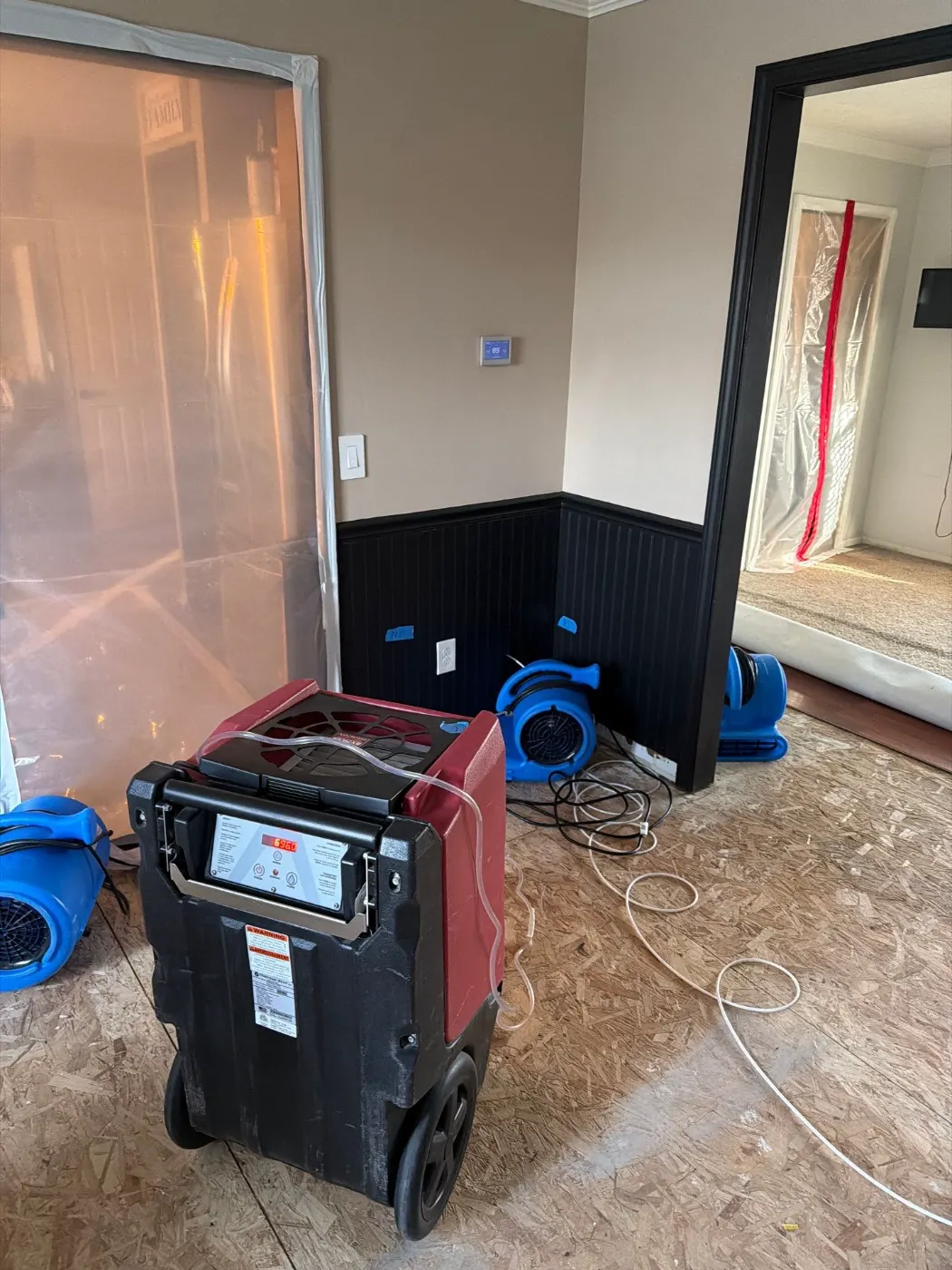
This is where amateurs cut corners. Proper drying requires the right ratio of air movers to dehumidifiers based on the affected square footage and the materials involved. For a typical 800 square foot Hamilton Proper basement, expect 12 to 18 air movers and 2 to 3 commercial dehumidifiers running continuously. We take moisture readings twice daily and adjust placement. Concrete and dense framing dry slower than drywall, so the last 20 percent of moisture removal often takes as long as the first 80 percent. Hamilton Proper Water Restoration technicians use both pin meters for wood framing and non penetrating capacitance meters for concrete and tile substrates to verify progress at each layer.
Day 4 to 5: Verification and Antimicrobial
Before equipment leaves, moisture content in framing should match unaffected baseline readings (typically under 16 percent for wood). Antimicrobial is applied to studs, subfloor, and any remaining materials to prevent mold colonization. A final thermal imaging sweep confirms there are no hidden wet pockets behind sill plates, under stair stringers, or inside wall cavities that escaped the drying plan.
When to Call Hamilton Proper Water Restoration
If water is still rising, if you smell sewage, or if the affected area is larger than a closet, stop reading and call. Every hour of delay adds dollars to your estimate and risk to your structure. Hamilton Proper Water Restoration runs 24 7 emergency response across Hamilton Proper and Central Indiana, we document everything for your insurance carrier, and if your situation is something we cannot handle well, we will tell you directly and refer you to someone who can. That is how we have built this company since 2018, and it is how we plan to keep operating.
What Drives the Price Up or Down
- Water category: Sewage triples labor and PPE costs compared to clean water
- Finished vs unfinished: Drywall, flooring, trim, and built ins multiply scope fast
- Response time: Calling at hour 2 versus hour 48 can cut costs by 40 percent
- Access: Walk out basements extract faster than bulkhead only access
- Square footage affected: Equipment count scales with area, not just depth
- Ceiling height: Tall basements need more dehumidification capacity per square foot
- Contents volume: Heavily stored basements add pack out, inventory, and storage fees
Questions to Ask Before You Sign Anything
- Are you IICRC certified, and can I see the technician certification numbers?
- Will you bill my insurance directly, and do you provide Xactimate formatted estimates?
- How many air movers and dehumidifiers will be on site, and for how long?
- Do you take daily moisture readings and provide a drying log?
- What is your guarantee if mold appears within 12 months?
- Is the deductible the only out of pocket cost, or are there non covered upgrades?
Frequently Asked Questions
How fast can Hamilton Proper Water Restoration get to my flooded basement in Hamilton Proper?
For active flooding calls in the Hamilton Proper area, we target on-site arrival within 60 to 90 minutes, 24 hours a day. Extraction usually begins within the first hour after arrival.
Will my homeowners insurance cover a flooded basement?
It depends on the source. Burst pipes and appliance failures are typically covered. Groundwater and sump pump failure usually require a separate water backup endorsement. Hamilton Proper Water Restoration documents every job to support your claim either way.
How long does it take to fully dry a flooded basement?
Most Hamilton Proper basements reach dry standard in 3 to 5 days with commercial air movers and dehumidifiers. Heavily saturated framing or Category 2 water can push that to 5 to 7 days with daily moisture readings.
Do I have to tear out all my drywall and flooring?
Not always. Category 1 clean water with quick response can often be dried in place with minimal demolition. Category 2 and 3 losses usually require removal of carpet pad, lower drywall, and any contaminated porous materials per IICRC S500 standards.
What does a flooded basement cleanup cost in Hamilton Proper?
Small clean-water jobs typically run $2,500 to $4,500. Mid-range losses fall between $4,500 and $9,000. Larger contaminated or structural drying jobs can reach $12,000 to $20,000 or more depending on scope.
Have a restoration question?
Our IICRC certified Hamilton Proper crew is ready to help. Free assessments, estimate based on what we can sees, no pressure.